Studios on Lylac are now accessible on the web.
Until now, studios have lived primarily inside the Lylac app. That made sense for collaboration, critique and creative exchange, but it also meant that sharing work outside the platform required a little more friction. Bringing studios to the web changes that. Every public studio now has its own link, allowing creatives to share their work with anyone, anywhere, while keeping the collaborative environment of Lylac intact.
For many creatives, portfolios on the internet have long required building and maintaining a separate website. That often means buying a domain, paying for hosting, learning how to set everything up, and then continuing to maintain it over time. Even after all that work, there is still the challenge of generating traffic so that the work is actually seen. For artists and designers who would rather focus on their practice, this can become an unnecessary layer of infrastructure around the work itself.
Web studios offer a simpler alternative. A studio can now function as a portfolio that is immediately shareable through a single link. Send it to a potential employer, collaborator or institution and it will open directly in a browser. If the person viewing it already has the Lylac app installed, the link will automatically open the studio inside the app, allowing them to move seamlessly into the native Lylac environment.
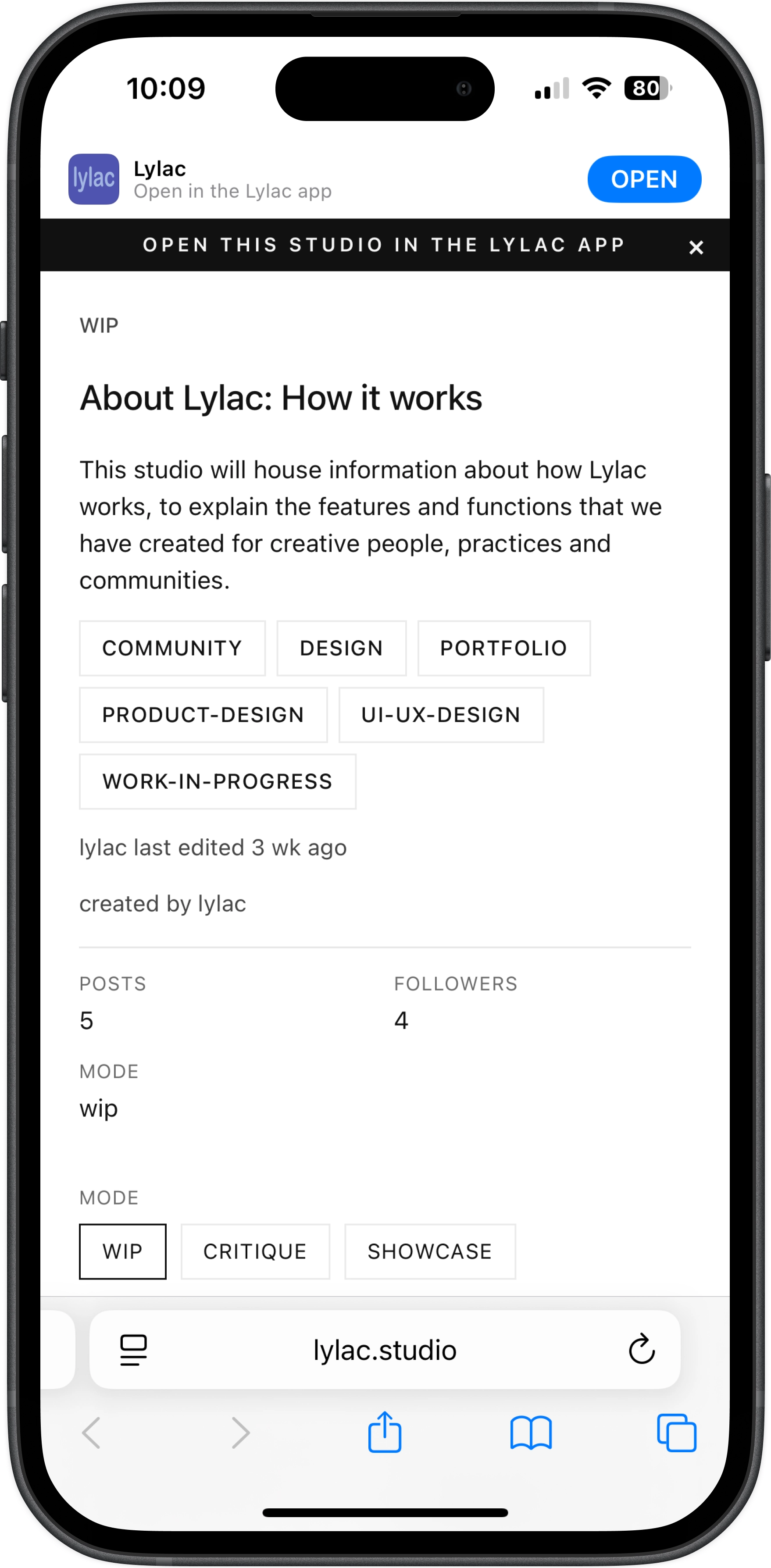
Studios can be opened in any browser and shared with a simple link, turning your Lylac space into a lightweight portfolio page.
What makes this particularly reassuring for creatives is that studios are already part of a growing global network of artists, designers and makers on Lylac. Even if a studio link is never shared externally, the work still exists within an ecosystem of like-minded creatives who are exploring, connecting and collaborating on the platform. Instead of spending energy trying to bring people to a standalone website, the work naturally sits within a creative community where it can be discovered by people who care about the process behind it.
Privacy and control remain exactly where they should be: with the creator. Only public studios are viewable on the web. If a studio is private, it remains completely inaccessible outside the app. And if a creator shares a public studio link but later decides to make that studio private, the web version will immediately stop working. The link simply ceases to function, reflecting the new privacy settings. Studios remain fully controllable from within the app.
Collaboration, critique and editing also remain inside the Lylac environment. By keeping these features native to the app, we can protect creative spaces from spam, bots and other forms of malicious activity that often affect open web platforms. The safety of our users and their work remains a priority, while still allowing studios to travel across the web when creators choose to share them.
Studios were always intended to be living spaces for creative work — places where ideas, experiments, works-in-progress and finished projects can exist together. Bringing them to the web simply extends their reach. Creatives can now maintain a studio inside Lylac where collaboration and creative exchange happen, while also sharing that same space publicly as a portfolio when the moment calls for it.
A studio that belongs to you, but can now move freely between the creative network and the wider web.